
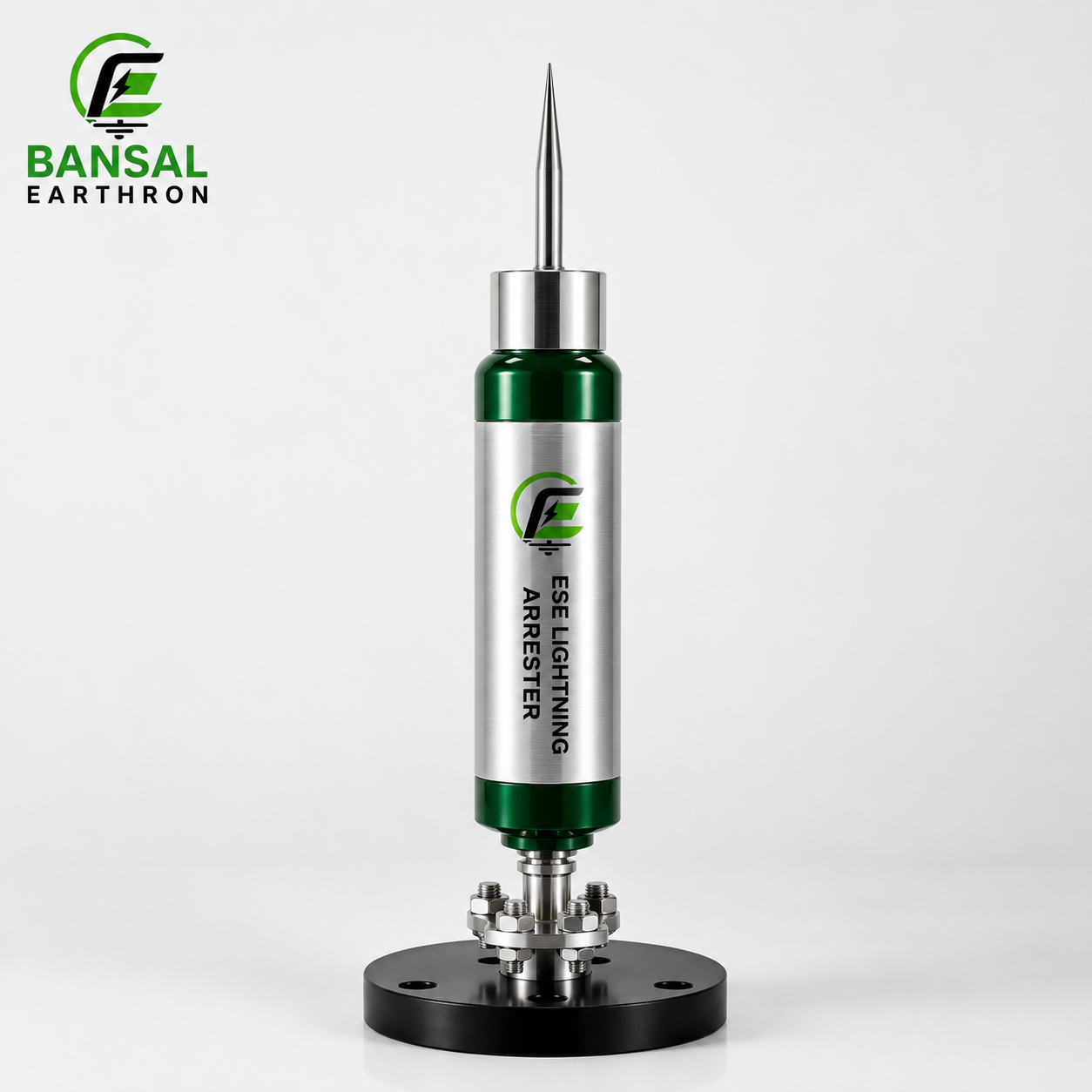
ESE Lightning Arresters
Early Streamer Emission, per NFC 17-102. During a storm, once field conditions are favourable, a Bansal Earthron ESE air terminal launches its upward streamer ahead of a standard rod — meeting the downward leader from the cloud sooner and giving a wider, more dependable zone of protection.
This earlier trigger time is what sets an ESE terminal apart from a plain rod exposed to the same storm conditions. Every Bansal Earthron ESE unit is high-voltage lab tested for its advance time (Δt), following the test procedure set out in Annex C of the French standard NFC 17-102 (2011 edition).
Get A QuoteThe protection radius (Rp) an ESE terminal covers is worked out as per NFC 17-102 (September 2011 edition). It depends on the lab-tested advance time (Δt) of the unit, the protection level chosen (I, II, III or IV) as per the applicable lightning risk assessment guides, and the mounting height (h) of the terminal above the area being protected — with a minimum height of 2 metres.
The radius is calculated per Annex C of NFC 17-102. For Bansal Earthron units, the Δt value used is capped at 60µs, in line with clause 5.2.2 of the standard.
Protection Calculation
Radius of protection (Rp) is derived from the standard formula given in NFC 17-102 (Sept. 2011), based on the terminal's advance time (Δt), installation height (h) and the required triggering distance (ΔL).
Where h = height of the ESE terminal above the area being protected (m)
Rp₅ = value of Rp from the first equation, taken at h = 5m

Safe Ground. Secure Life. Engineered chemical earthing electrodes and accessories, manufactured by Bansal Poles Pvt. Ltd. for pan-India supply.